
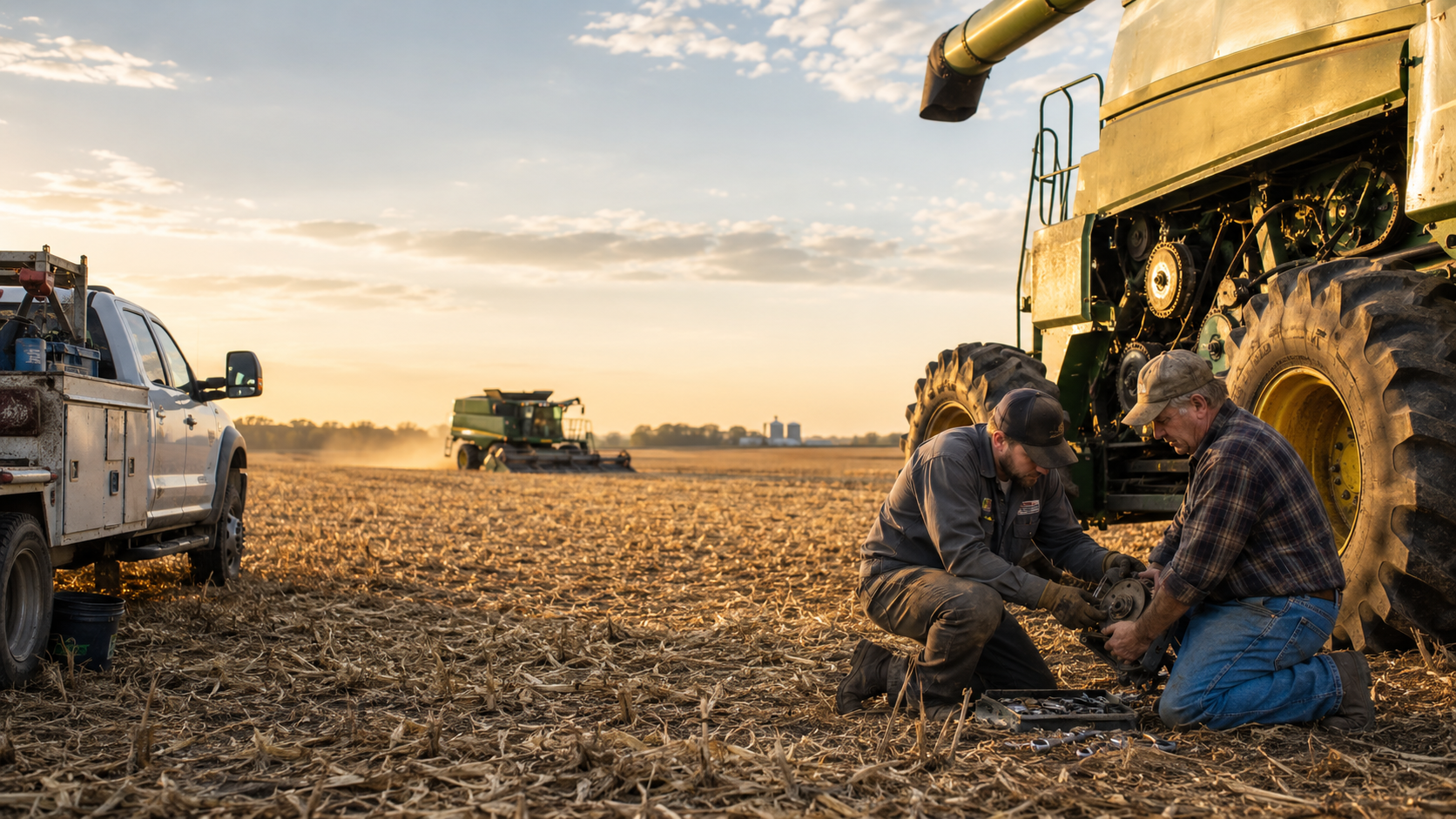
What a Broken-Down Combine Can Teach Michiana Manufacturers About Emergencies
Ask any farmer in Marshall County what happens when a combine breaks down mid-harvest, and you'll get the same answer every time: it's not really an emergency. Not for the ones who've been doing this a while. They already know which parts wear out first, they've got a relationship with the dealer who can get them a replacement fast, and they've got a plan for keeping the rest of the operation moving while one machine sits idle. The breakdown is a bad hour. It's not a disaster, because nobody's figuring it out for the first time in the field.
Most manufacturers handle their own breakdowns the opposite way. A system fails, a file disappears, the internet drops mid-workday, and a handful of ordinary questions suddenly don't have quick answers. Who's calling the shots on this one? What needs power first? Should someone be on the phone with clients right now, and if so, saying what exactly? A lot of owners have spent real money on backups, firewalls, and newer hardware. Far fewer have spent any time on how their team actually behaves once something breaks, and that gap sits invisible right up until the day it isn't.
Here's what happens in that gap. Someone has to stop and decide something that should have already been decided. Then someone else waits on that decision before they can act. Work stalls in one department while people in another department have no idea anything's wrong yet. None of this is anyone's fault exactly. It's just what happens when a team meets a problem it's never rehearsed.
Customers notice next. Replies slow down. Updates get inconsistent, because whoever answers the phone is guessing at the same things the team is guessing at internally. A manufacturer that's usually reliable suddenly isn't, and that's the part clients remember longest.
Take two manufacturers in Goshen, both knocked offline by the same kind of outage on the same kind of morning. Neither one caused it and neither one saw it coming. The difference shows up in what happens in the first hour. In one plant, somebody already knows they're the one making the calls, the order of what gets fixed was settled weeks ago, not in the moment, and the shift supervisor has a script ready for the customers calling about their order. In the other plant, three people are having the “who's handling this” conversation for the first time, live, while the phone keeps ringing. By early afternoon, the first plant is back to normal production. The second is still sorting out who was supposed to call the internet provider. Same outage, same size, wildly different afternoon, and none of it came down to luck.
We've been in the room for plenty of these across Michiana, watching one client lose an afternoon and another lose barely a beat to the same kind of trouble. What separated them was never the size of their IT budget. It was whether someone had already sat down, before anything went wrong, and worked out who does what.
That's the part of this job that isn't about fixing servers. It's making sure a client isn't building their response from scratch the same day everything's already going wrong. The farmer with the combine isn't calm because breakdowns don't happen to him. He's calm because he decided, long before harvest, exactly what he'd do the day one did.
The next time something breaks on your floor, will your team be running steps they already know, or figuring out the steps for the first time while the clock's running? Schedule a 10-minute discovery call and we'll help you find out. Call 574-857-4332 to get started.